The New Age of Web Development
Less Code, Faster Iteration: AI and Smarter Tools Accelerate Productivity in Modern Web Development
Passionate about software development and architecture, web and cloud technologies, as well as game development.
Web development today is nothing like it used to be: With the rise of web apps, frameworks, and developer tools have matured massively. And now there are even specialized AI assistants for web development. That makes it easier than ever: these days, almost anyone – even without deep prior knowledge – can throw a website or app online in no time, though the quality might be questionable. With the right prompt and an AI assistant, you don’t even need to fully understand all the concepts – the AI writes along, explains, optimizes, and can even deploy it for you if you want.
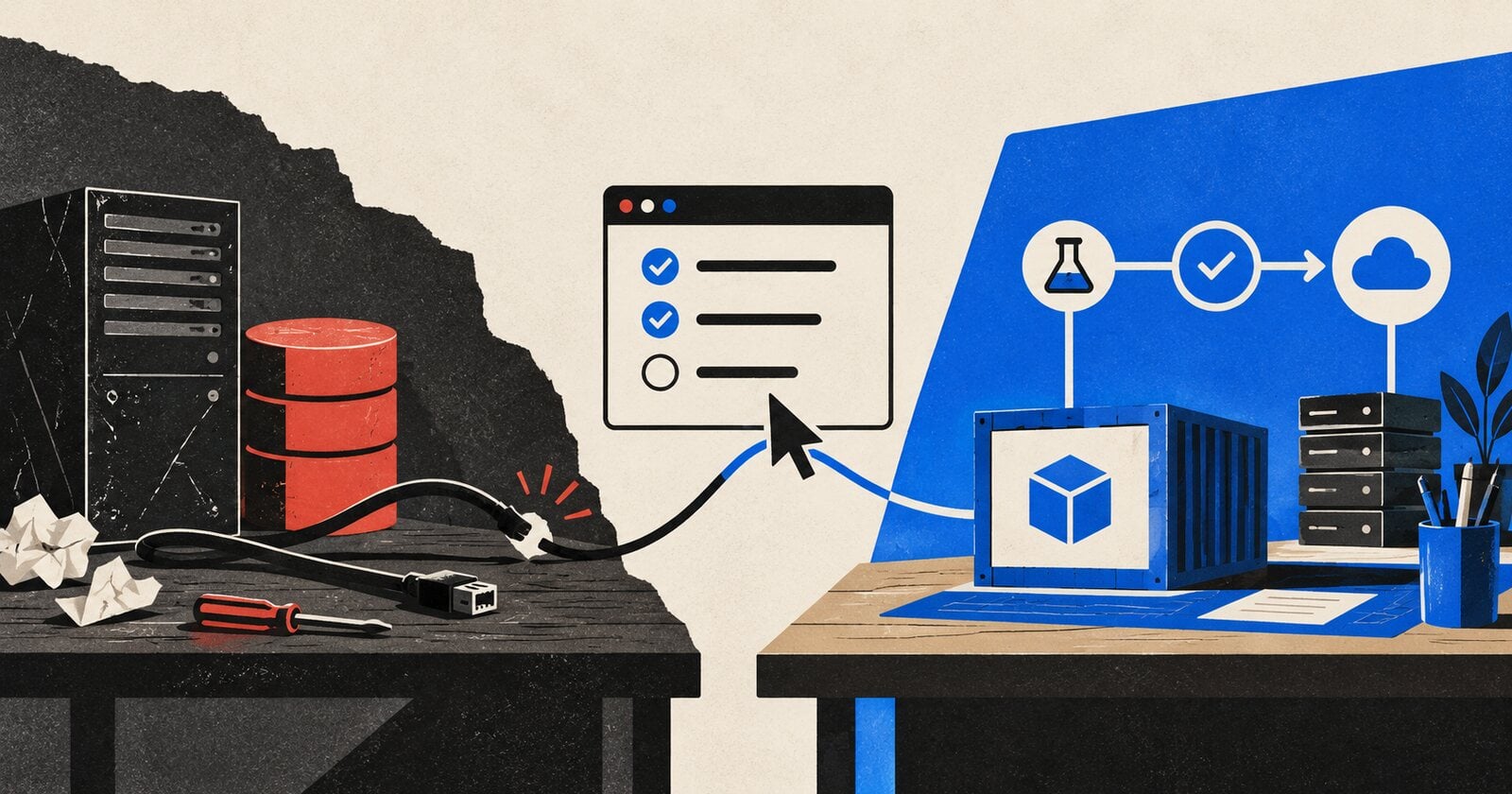
Ten years ago, if you wanted to build something as simple as a to-do list web app, you’d write the backend in PHP with MySQL, do the layout in HTML, and style it with CSS. Maybe you’d use jQuery to add some interactivity. Even the languages themselves have changed drastically since then. To publish your finished app, you’d rent a server, install Apache, and upload everything with FileZilla.
CI? CD? – meaning continuous integration and automated deployment – barely anyone talked about that. The term DX, or Developer Experience (a term inspired by UX), wasn’t really a thing either. A few frameworks were ahead of their time, but mainstream web development? Rare.
Developer Experience is now more important than ever
Today it’s a whole different story: web apps have become hugely popular because they’re central to digital life and instantly available. Unlike traditional software, you can reach them from your phone with just a couple of taps – no downloads needed. That explains the massive commercial interest driving this space.
Instead of fiddling with vanilla HTML, CSS, and JavaScript, people now reach for frameworks like React, Vue, or Svelte. You don’t even need to write your own backend anymore – services like Firebase, Supabase, or other BaaS (Backend as a Service) providers let you get started immediately. And if you do need your own backend, you’ll probably write it in TypeScript with a full-stack framework like Next.js or Nuxt, and deploy it straight to Vercel or Railway – no server setup required.
The CI/CD process? Drag-and-drop it together and run it free on GitHub Actions, GitLab Pipelines, or Bitbucket Workflows. It all plugs right into modern dev workflows: push a branch, tests run automatically, linters check code quality, and after merging, it deploys instantly – often with preview environments for each pull request.
Developer Experience has become a defining quality factor. VS Code with smart IntelliSense, live reload, and hot module replacement increases the iteration speed. One can push with confidence thanks to testing tools like Storybook and Playwright. Errors show up immediately, feedback cycles are short, and onboarding new devs takes hours, not weeks.
Design and UX are tightly integrated, too. Figma files can be turned straight into code, Tailwind CSS or CSS-in-JS make styling predictable and reusable. What once took weeks now gets done over a weekend – or even in an afternoon with the right stack.
In short, web development today isn’t just easier – it’s faster, more scalable, more collaborative, and more accessible. The entry barrier has dropped, but the professionalism you can reach with minimal effort has exploded. What once needed a team with complex processes, a single dev can now do in an afternoon.
Enter the age of AI assistants
The next evolutionary step in web dev is not just easier – it’s partly automated. AI-powered tools like GitHub Copilot, ChatGPT, Codeium, or Cursor can now write large parts of the code. They don’t just suggest syntax; they understand (if you can call it that) context, architecture, design patterns, and sometimes even business logic.
Even if humans still implement the final solution, it makes sense to let AI assistants like CodeRabbitAI, Copilot, or CodeGuru review it.
Want to prototype a new app? Drop a prompt – 15 seconds later, you’ve got a working React setup with tests, styling, and documentation. Need an API? Generate the OpenAPI interface and ask the AI to generate the deployment commands for Vercel with it. Want a feature with auth, validation, and DB integration? With the right prompts and templates, you’re production-ready in minutes.
The to-do list as the “Hello World” of web dev
A concrete example: the modern to-do list app. Why? Because it’s the perfect example that touches many aspects of web development. It’s become the “Hello World” of the field – almost every language and framework has one.
ChatGPT suggests the tech stack. After a few prompts, I have a VS Code dev container running Node and Bun (a modern NPM alternative, written in Zig - btw, I have written about Zig previously if you are interested), with all dependencies and editor extensions preinstalled.
Next.js makes it easy to spin up a full-stack app. I run bunx create-next-app@latest, hit Enter a few times, and I’m set.
With v0 (Vercel’s AI – the same people behind Next.js), I generate the frontend:

The free version already produces a fully working result: styled with shadcn/ui, which builds on TailwindCSS and Radix UI and makes it super easy to build interactive frontends.
A couple more prompts later, I have a working backend using React Server Actions with a PostgreSQL database schema. v0 even offers to spin up a database for me, hosted on Neon (serverless Postgres with a generous free tier).
I import the v0 project into my local Next.js setup in VS Code. From here, I use Cursor, a VS Code fork with AI baked in, to support further development. Adding auth? Easy – just plug in Clerk or BetterAuth. Want to provide an API? Next.js App Router basically has you covered already.
Deployment is just: push to GitHub → connect repo to Vercel → assign a domain → optionally set up a GitHub Action for linting and tests. Done. A working prototype or project foundation in under 60 minutes – thanks to modern tooling + AI.
Of course, these tools are just an exemplary selection of mine. There are plenty of alternatives that can achieve the same. The key is: combining smooth modern DX with AI changes not only how we develop, but who can develop. The barrier hasn’t just dropped – in many cases, AI has erased it.
At the same time, these tools deliver a level of quality and speed that was unthinkable just a few years back. For large production systems, it’s still another story – scaling, observability, security, architecture, code quality – all of that matters, and AI still struggles there. But even in those areas, AI and modern tooling are changing how we solve problems, organize teams, and deliver innovation faster.
The future? Prompt-Driven Development
Prompt-Driven Development – building through targeted interaction with AI assistants – is shaping up to be the next core dev skill. Instead of writing every line manually, developers describe behavior in natural language and get structured code, components, or configs back.
The crucial skill is formulating clear, precise, contextual requirements. Those who master it will build faster, offload repetitive work, and crank out complex prototypes solo in record time – things that used to take entire teams.
But architecture thinking, responsibility, and systems knowledge remain essential. AI can suggest code, make architectural choices, and sketch out complex systems – but only if it’s given enough context. Without that, it operates probabilistically, remixing common solutions from training data and making assumptions that might not fit.
AI is not a magic bullet
The quality of AI output will never be exceptional – LLMs don’t invent original solutions, they remix averages from their training data. The result is functional but not innovative, not optimized, not consciously designed – just a recombination of millions of examples.
Those who give precise prompts and control what’s generated will gain a lot – for prototyping, repetitive building blocks, or initializing project parts. The efficiency boost doesn’t come automatically from AI, but from knowing how to use it: setting goals, judging drafts, validating choices.
AI isn’t a replacement for technical thinking – it’s a multiplier. If you know what you want, you’ll get it faster. If you don’t, you’ll just automate chaos.
AI won’t replace developers. If anything, it tempts devs to switch off their brains and just accept its output. That’s dangerous: misuse it or use it carelessly, and you’ll introduce bugs or overwrite code you didn’t mean to.
A 2024 Atlassian survey on Developer Experience found two-thirds of devs haven’t seen major productivity gains from AI tools yet. Still, 61% are optimistic that this will improve in the next two years.
From automation to augmentation – the new developer role
The whole mindset around DX and great tooling has only really emerged in recent years, but the pace has been incredible. And it’s still evolving fast. We’re standing at the edge of a new phase in software dev.
Past tools automated repetitive tasks. Today’s AI systems assist with thinking, decision-making, and even design. It’s no longer just about efficiency – it’s about augmentation: extending our capabilities with smart assistants.
The developer role is changing noticeably: instead of writing every line of code, we structure ideas and workflows that AI quickly turns into prototypes. We define requirements, prioritize, validate, and iterate. The focus shifts from syntax and implementation detail toward architecture, system design, and product logic.
The premise: this change will lead to far more efficient development. Whether it actually delivers – we’ll see.